
-
About
-
Products
- By Timber Product
- Cladding
- Decking
- Joinery
- Screening
- Panelling
- View all
- By Application
- Exterior Cladding / Siding
- Exterior Rain Screen
- Exterior Roofing
- Interior Walls & Ceilings
- Soffits
- Screening, Fins & Battens
- Windows, Doors & Joinery
- Posts & Beams
- Accessories
- Coatings
- Fixings
-
Resources
- Projects
- Contact





Long Term Durability Trial: Abodo Radiata Outperforms Cedar
After more than seven years of independent testing, our long-term decay trial results are in.
There are no two ways around testing the decay resistance of timber in an outdoor environment – it can only be achieved through time and patience.
To ensure we had data to back up our claims around longevity and performance, we ran our timbers and several alternatives through a 91-month outdoor trial, with the impressive results proving our thermally modified wood outperforms imported old growth and chemically treated timbers, remaining structurally sound through over seven years of wind, rain and sun.
About the trial
To find out how well our timbers performed over time, we created a real world simulation of accelerated decay conditions at our test site in Māngere[1]. Samples of Vulcan cladding and decking timber were placed on above-ground angled racks and horizontal decks, alongside a selection of other timbers. Sample panels included:
- Untreated Radiata pine
- Treated Radiata pine
- Abodo thermally modified Radiata pine
- Western red cedar
- Eucalyptus grandis
Timber samples were placed in contact with untreated wood to speed up timber failure and severe decay conditions. We then left them exposed to rain, sun, and whatever else the area's sub tropical climate could throw at them, for over seven years.
During and after the trial period, independent assessments were undertaken by wood protection consultant Jeanette Drysdale, who analysed the durability of the timber using a decay rating scale, where 0 = complete degradation, and 10 = no decay.
Durability over time
This chart illustrates the decay performance of all tested species over time, in the angled rack test.
A high 'decay rating' indicates greater decay resistance.

Angled rack results
The angled (flat panel) rack was positioned to replicate a section of cladding with accelerated decay conditions around the end grain. Jeanette’s findings showed that many of the alternative timber samples did well for around 4-6 years before suffering significant decay. Here are some of her key findings:
- Abodo’s thermally modified Radiata pine remained in a consistent condition over the trial period with an average rating of 9.5 seen at the end of the trial.
- Western red cedar showed a significant drop in performance after 54 months, with a final rating of 4.2 at 94 months.
- Eucalyptus grandis performed well initially but declined over time, with a significant drop seen at 67 months and a final average rating of just 2.4.
- Untreated Radiata pine degraded rapidly, reaching a decay rating of 0 by month 91.
- Copper Chrome Arsenic (CCA) treated Radiata pine also dropped at the 67 month mark with a final average rating of 7.4.
Aside from these numerical ratings, Jeanette also observed the timber for signs of decay, discoloration and misshaping, with these findings:
- Abodo thermally modified Radiata pine remained in better condition than the CCA treated pine sample over the course of the trial.
- As well as decaying over time, the surfaces of the Western red cedar samples showed signs of ridging (where the grain begins to rise from the surface) and some cupping.
- Some fungal degradation was observed in the areas where the Western Red Cedar made contact with the back-support panel.
- While some Eucalyptus samples did not decay significantly, white streaks could be seen on some surfaces, indicating that white rot could be present. Edges were also decayed where they had been in contact with the supporting frame.
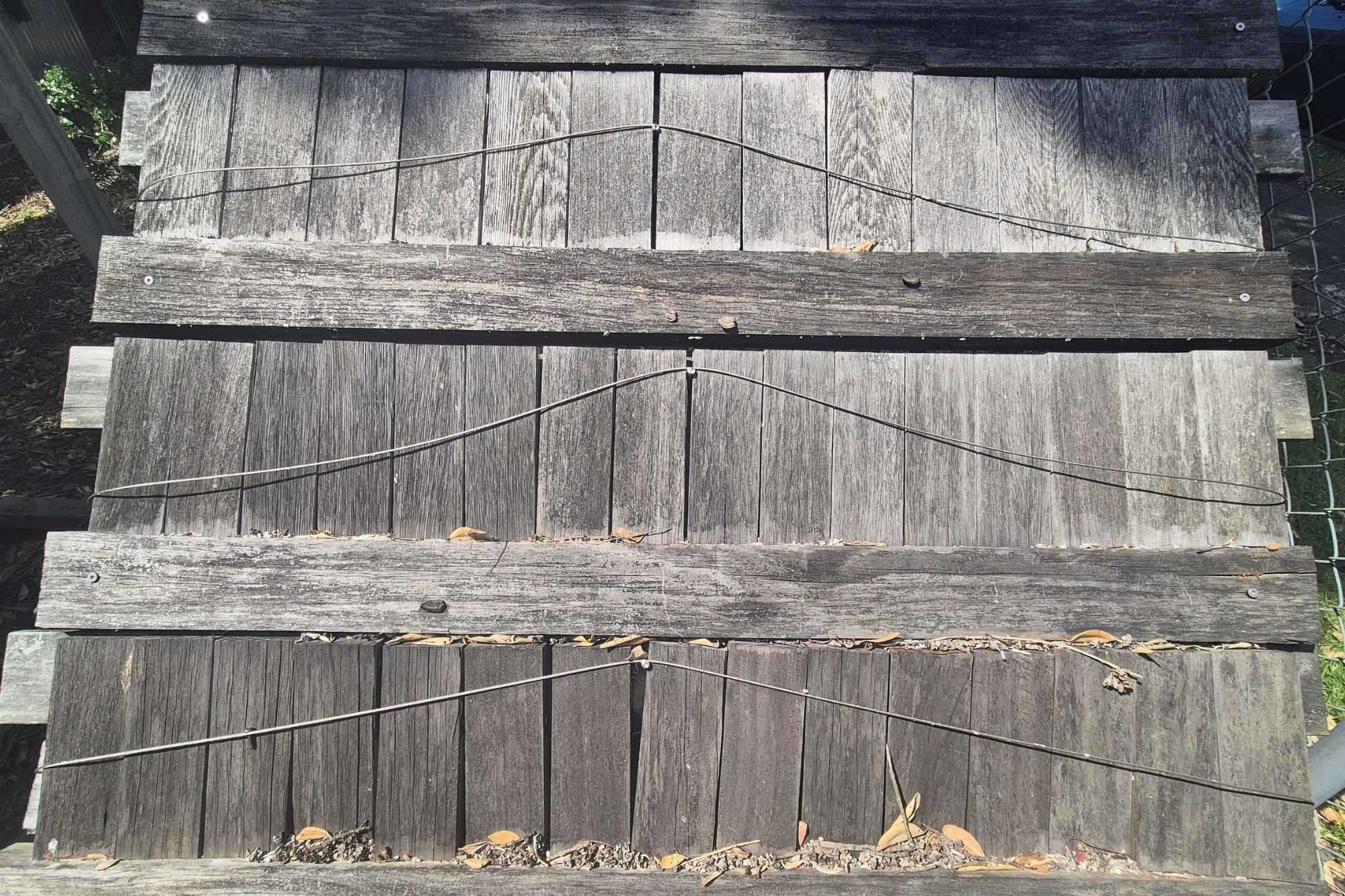
Ground proximity flat deck results
For this trial, samples of the same timber varieties were laid out on racks close to the ground, imitating common usage which can exacerbate decay.
Aside from Abodo, this trial resulted in faster decay than the tilted trial, as seen in these findings:
- Abodo thermally modified timber samples had a mean rating of 10 by the trial’s end, including samples of 12mm plywood.
- The untreated Radiata pine samples had decayed completely by the end of the trial (with a mean rating of 0).
- For the CCA treated Radiata pine sample, the deck boards in close proximity to the ground fared better than the samples in the angled trial. These samples had a mean rating of 10 by the trial’s end.
- Western red cedar suffered decay at a mean rating of 7.6 and also showed some softness where the timber had been in contact with other samples.
- Eucalyptus grandis had a mean decay rating of 8.5 by the trial’s end.
The Results Are Clear: Abodo New Growth™ Timbers are a Genuine Alternative
The data proves that Abodo thermal modification enhances and stabilises timber without the need for chemical treatments, aligning with Abodo’s vision for creating sustainable, renewable and non-toxic alternatives to old growth and chemically treated timbers.
[1] The field trials followed the AWPC Protocols for Assessment of Wood Preservatives, September 2015.